BHP’s Mikko Tepponen presented a framework for applying data, artificial intelligence, and automation across the mining lifecycle, positioning execution discipline and system integration as the key determinants of long-term competitive advantage.
The central message was direct. Technology alone does not create value. Execution does, but it’s harder than it sounds.
Mining is getting squeezed from both ends. The easy ore bodies are largely gone; what’s left tends to sit deeper, with more complex geology and higher mining costs. Meanwhile, demand keeps climbing.
Copper, iron ore, battery metals, and rare earths are required for electric vehicles (EVs), growing cities, energy infrastructure, and decarbonization. The world wants more, and the ground is getting stingier about giving it up.
That gap is why BHP thinks the industry needs to get smarter about decisions, from where to drill, what to mine, and how a processing plant runs daily.
AI is a Tool, Not a Magic Trick
BHP doesn’t think that AI in mining is a secret magic trick that automatically prints money. It sees AI differently.
In mining, every company is basically using the same machines and processes. The data they collect isn’t some “top-secret” advantage because most companies are looking at similar numbers. Since everyone has the same tools, you don’t win just by owning the technology; you win by being the fastest to use it.
Think of it like a race where the lead can disappear in a few months. Companies have to get the AI working on-site immediately. The goal isn’t just to buy a smart program; it’s to weave it into the daily mining procedures better than your competitor.
You can’t just win once and relax. If you stop moving and improving, your competition will pass you before you even realize you’ve slowed down.
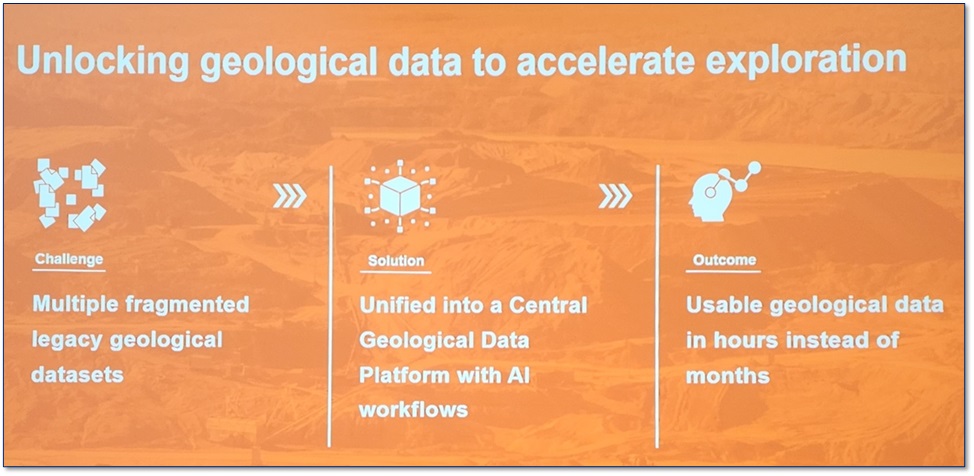
FIGURE 1: Unlocking Geological Data
Cleaning Up the Data “Spaghetti”
Before any exciting AI stuff can happen, there’s the reality of mining’s data history. Tepponen described the current state of most large operations as “spaghetti”, thousands of disconnected software systems, data in formats that don’t talk to each other, workflows that grew up over decades without any real design behind them.
BHP is transitioning to a cleaner three-layer structure:
- Data Layer: Focus on solutions to make sure data stays consistent across systems.
- Logic Layer: AI models would interpret and link the data.
- Experience Layer: it. Where people actually interact, running simulations, asking questions in plain language.
It’s a simple idea, but hard to build. And it only works if the data underneath is actually clean and connected, which is its own project.
A Century of Geology, Finally Searchable
One of the bigger wins so far is in exploration. BHP built a platform pulling together decades of geological records, millions of drill holes, thousands of surveys, and 52 types of geoscience data into one searchable place. A lot of the data was sitting in old paper files or legacy formats, basically invisible to any modern analysis tool.
AI now reads through those archives and extracts useful data automatically. What used to take months of manual work takes hours. Geologists spend less time digging through old files and more time deciding where to drill next. Less wasted money, faster decisions.
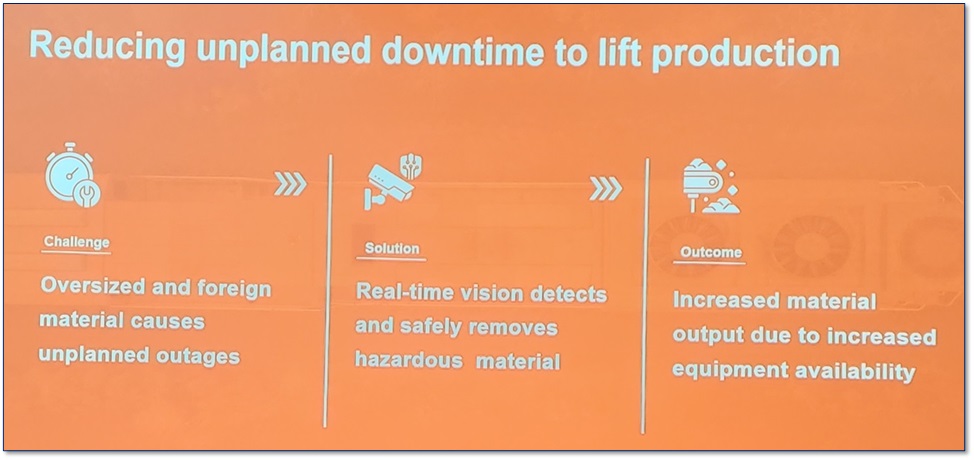
FIGURE 2: Reducing Downtime to Increase Production
Cameras Catching what Humans Miss
In iron ore, the problem is more physical. Big chunks of rock or stray debris occasionally end up on conveyor belts. When that happens, downstream damage can shut down production. Catching it used to depend on operators watching closely or noticing something wrong after the fact.
BHP put computer vision on those belts. Cameras that watch continuously and trigger automatic shutdowns when something looks off. The result was a near-elimination of the major disruption events that used to eat into production time. Not glamorous but very effective.
Escondida and its Digital Twin
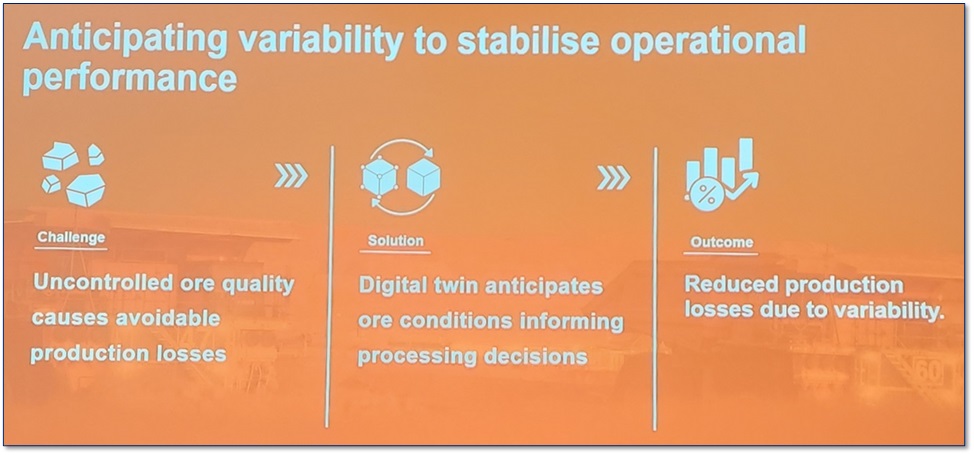
At Escondida in Chile, the ore coming out of the ground varies constantly (different hardness and chemistry) and that variability throws off the processing plant in unpredictable ways. The old approach was to react after problems showed up.
BHP built a digital twin: a virtual version of the mine and plant that runs on real data and simulates what’s coming. Operators can now anticipate variability and adjust before it affects real production. The company reported roughly a 70% reduction in production losses tied to ore variability. That’s a meaningful amount of extra copper that would have otherwise been lost.
FIGURE 3: Anticipating Variability
No one has enough data alone
Here’s the part that doesn’t get talked about enough. BHP, for all its scale, admits it doesn’t have sufficient data to fully optimize everything by itself. The geological picture is too big and too patchy.
This problem is pushing the company toward something unusual: actively sharing data with competitors and research institutions in areas where everyone benefits. Safety is the best example.
Mining fatalities rose 27% between 2022 and 2024. AI can spot patterns across thousands of incidents, but only if companies stop hoarding the data. BHP is pushing for shared safety databases. Whether the rest of the industry follows is another question.
$2 Billion in Valuation Creation
Over the past four years, BHP says it has pulled more than US$2 billion in value from digital and analytics work across exploration, operations, and logistics. And Tepponen still called it the early days.
The end goal is an operation where geological data feeds the blast plan, the blast plan feeds the processing strategy, and all of it learns from what’s actually happening on the ground. Getting there means building common data standards, connecting legacy systems, and convincing competitors to share data they’d rather keep private.
Technology provides the capability, but efficient and connected systems are what create the value. You can buy the tech, but you have to build the connections to see the profit.
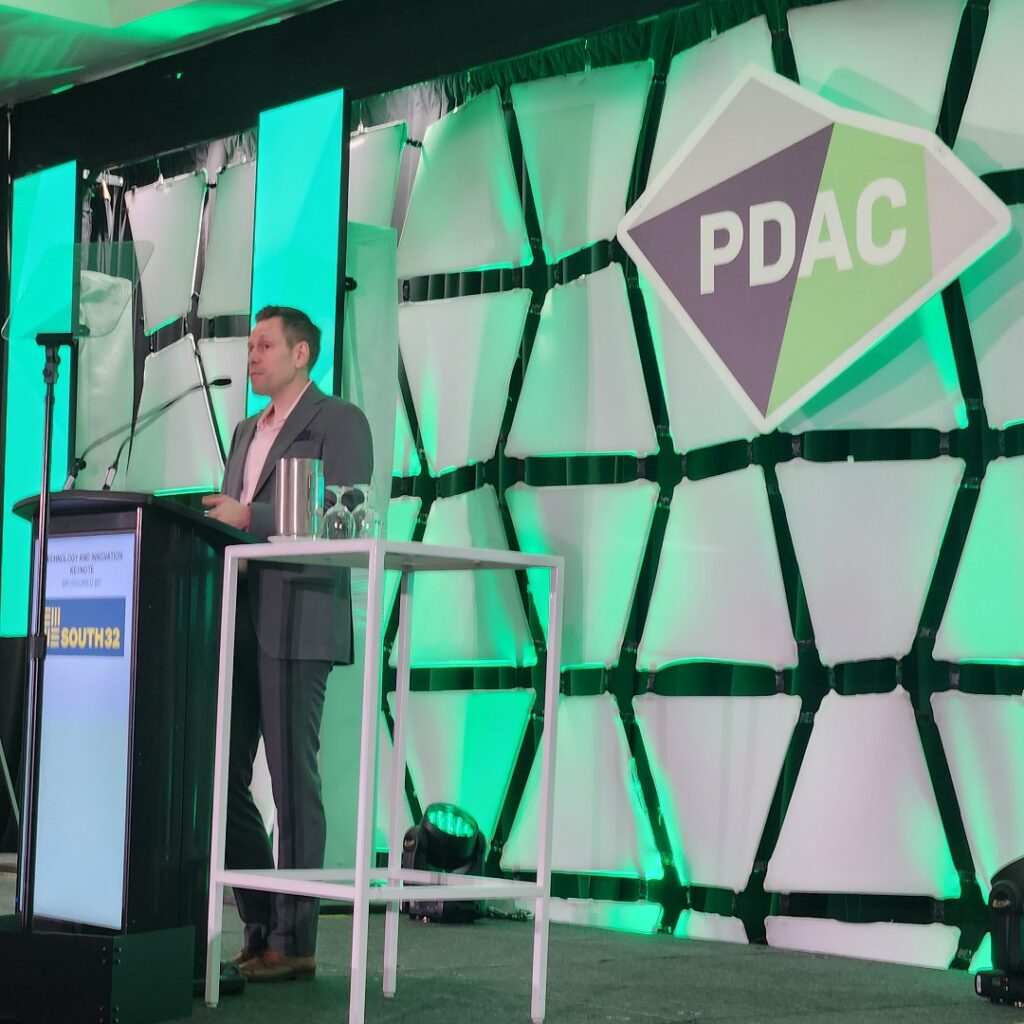
FIGURE 4: Mikko Tepponen, Digital Officer, BHP at PDAC 2026
Notes: The author, employees, consultants, and family of eResearch may own stock positions in companies mentioned in this article, report, and/or video, and may have been paid by a company mentioned. eResearch offers no representations or warranties that any of the information contained in this article is accurate or complete. Content on eresearch.com is provided for general informational purposes only and does not constitute financial, investment, tax, legal, or accounting advice, nor does it constitute an offer or solicitation to buy or sell any securities referred to. Individual circumstances and current events are critical to sound investment planning; anyone wishing to act on this information should consult with a financial advisor. The article may contain “forward-looking statements” within the meaning of applicable securities legislation. Forward-looking statements are based on the opinions and assumptions of the Company’s management as of the date made. They are inherently susceptible to uncertainty and other factors that could cause actual events/results to differ materially from these forward-looking statements. Additional risks and uncertainties, including those that the Company does not know about now or that it currently deems immaterial, may also adversely affect the Company’s business or any investment therein. Any projections given are principally intended for use as objectives and are not intended, and should not be taken, as assurances that the projected results will be obtained by the Company. The assumptions used may not prove to be accurate, and a potential decline in the Company’s financial condition or results of operations may negatively impact the value of its securities. Please read eResearch’s full disclaimer.