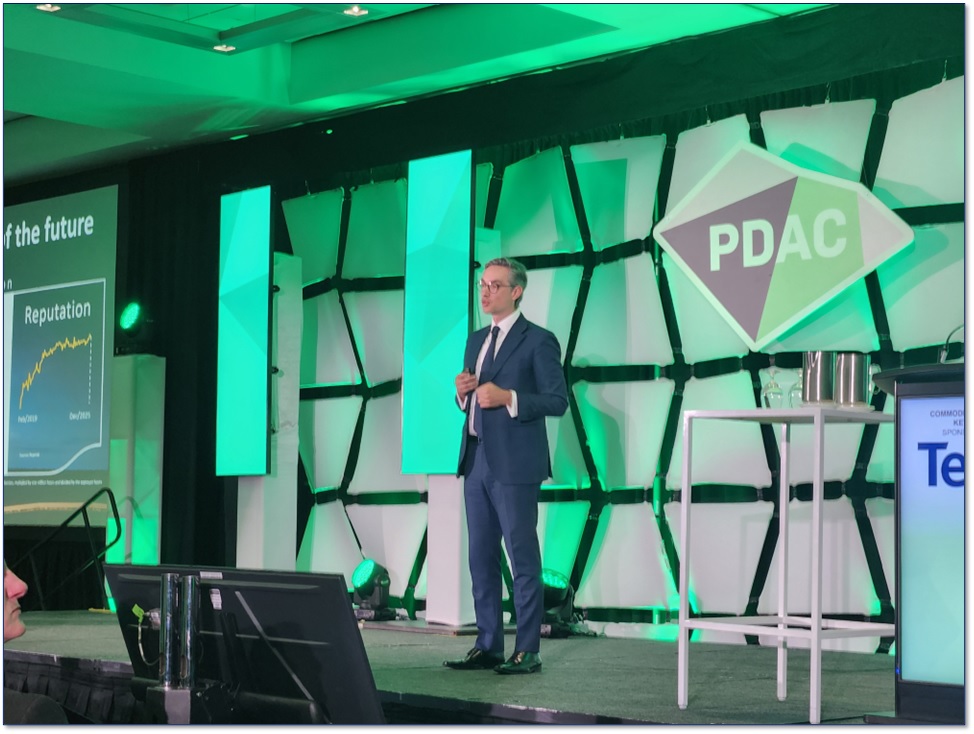
At the Prospectors & Developers Association of Canada (PDAC) 2026 Commodity Outlook Keynote, Gustavo Pimenta, CEO of Vale S.A. (BOVESPA: VALE3 | NYSE: VALE), made a general case that mining is at the heart of global economic transformation, but the sector continues to fail to gain social acceptance.
Speaking to a full room in Toronto, Pimenta positioned the sector as a key to electrification, artificial intelligence, and supply chain security.
“There is no AI without mining. There is no energy transition without mining,” he said.
However, he also acknowledged a disconnect. As the demand for minerals is projected to increase, possibly by five to six times the current levels, mining firms are still trading at low prices in comparison to their economic significance.
A Sector Central to Global Growth
The main message of Pimenta was simple. Mining is no longer a background industry. It now supports a number of structural changes, such as decarbonization and digitalization.
At PDAC, organizers positioned the sector as central to “energy transition, AI revolution, [and] supply chain resilience.”
Pimenta pointed to sustained demand across key commodities. Mineral supply, he argued, will need to increase by a factor of five to six times current production to meet the demand caused by electrification, AI infrastructure, and decarbonization.
Even iron ore, which is frequently dismissed as a mature commodity, still has a major role to play as the world infrastructure is being built out and the steel industry is moving off fossil fuels.
He emphasized that market recognition has lagged. The combined market capitalization of the top 300 mining companies is less than that of Nvidia (NASDAQ: NVDA), a single large technology firm. That gap, he argued, reflects not just market dynamics, but perception.
Rebuilding Trust and Social License
One of the themes that kept recurring in the speech was the license to operate in the industry. Pimenta claimed that mining companies should not just be necessary.
“We have to go beyond being essential,” he said. “We have to make sure that we are an interested partner.”
This change, according to him, is not cosmetic. It has a direct impact on valuation, permitting, and long-term project viability.
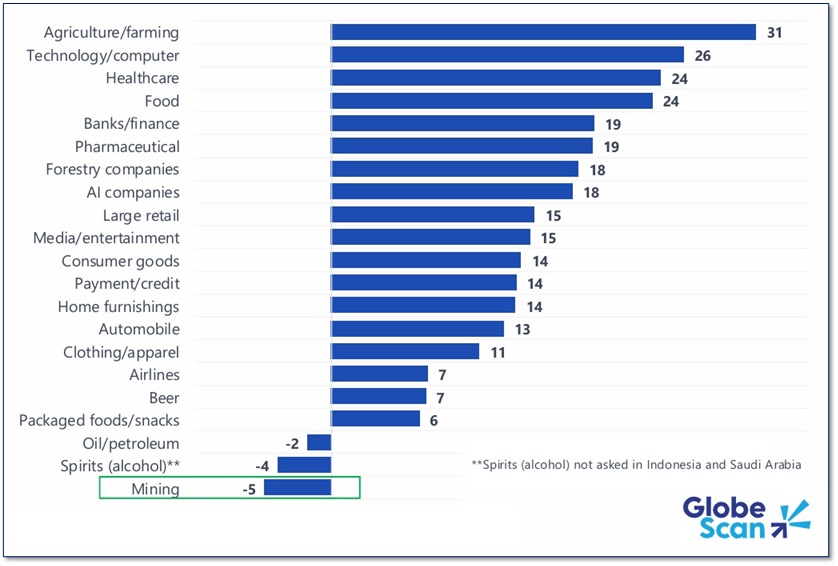
Survey data presented indicated that mining is not highly rated by the population in various countries. That perception gap, Pimenta proposed, constrains capital flows and project approvals.
As a result, Vale’s strategy focuses on showing practical social and environmental positive outcomes, instead of relying on the argument that mining is unavoidable.
FIGURE 1: Survey of Performance of Sectors in Fulfilling Responsibilities to Society
The Five Pillars of “Mining of the Future”
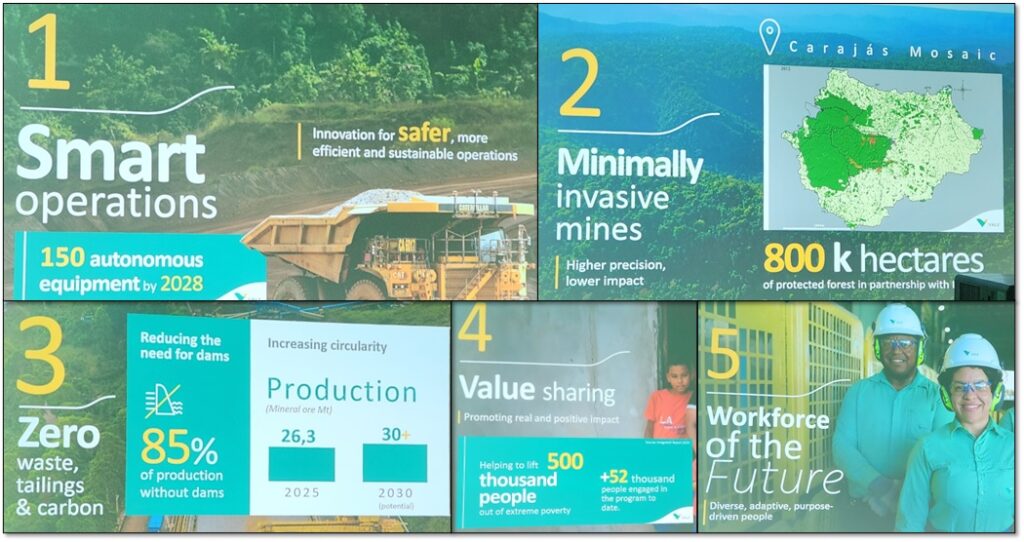
To address these challenges, Pimenta outlined a five-pillar framework for what he called the “mining of the future.”
- Smart Operations
- Vale is expanding automation and digitalization. At its Brucutu mine in Brazil, autonomous operations have improved both safety and efficiency. Pimenta claimed that the industry is still in the initial stages of embracing advanced technology.
- He said the industry remains in the early stages of technology adoption, with significant room to expand automation and data-driven decision-making.
- Minimally Invasive Mining
- The company is trying to minimize land and water consumption. As an example, Vale has been working on approximately 3% of the land in the Carajás region and preserving the remaining 97%, a strategy that Pimenta termed as economically sustainable conservation.
- According to Pimenta, Vale is already working to extend this approach to other sites, combining technology, security, and partnerships to protect surrounding land while maintaining production.
- Zero Waste and Lower Carbon
- Vale is transitioning toward dry stacking to eliminate tailings dams and is targeting Scope 3 emissions through product innovation, including lower-carbon iron ore briquettes.
- The approach also extends to customers, with Vale developing products designed to lower emissions in steel production.
- Shared Value
- The company has established a goal of assisting in raising 500,000 individuals out of poverty by means of local economic development projects.
- He noted that Vale is working with researchers at Oxford University to develop a methodology that goes beyond financial aid, focusing instead on measurable improvements in income, health, and education.
- Workforce Transformation
- Vale is investing in diversity and skills development. The number of female employees has grown from 13% to 26%, which is a more general cultural change in the company.
- However, Pimenta emphasized that workforce development must evolve in parallel with technology adoption to support long-term productivity gains.
Pimenta referred to these pillars as strategic levers that would help Vale regain its long-term competitiveness and valuation.
FIGURE 2: Vale’s Five Pillars
Operational Focus and Portfolio Discipline
In addition to the larger framework, Pimenta emphasized a narrower corporate strategy.
Vale is focusing on three main commodities, which include iron ore, copper, and nickel. He admitted that previous diversification into new commodities had watered down returns.
“We have something that nobody has,” he said, referring to Vale’s resource base and infrastructure.
The company has a target of 360 million tonnes of iron ore with minimal incremental capital, and produced 336 million tonnes of iron ore last year. The current copper production of approximately 380 kilotonnes has the potential to be doubled with the current infrastructure.
This strategy is indicative of a move towards capital efficiency and brownfield development as opposed to massive new developments.
Addressing Long-Term Industry Constraints
Pimenta also touched on structural issues in the industry during the Q&A session.
To begin with, there is the issue of talent shortages. He observed a reduction in the number of mining engineers in the world and the necessity of closer collaboration with universities and technical schools.
Second, community engagement continues to be critical. Vale is using data-driven approaches, including collaboration with academic institutions, to measure poverty reduction and social outcomes in mining regions.
Lastly, he recognized that closure planning, which is usually ignored, should be incorporated earlier in the project development. He said that to restore trust, it is necessary to give back land to communities in a form that can be used.
From Essential to Valued
Pimenta had come back to where he started, to perception.
Production alone will not bridge the valuation gap, he argued. It will close when society stops seeing mining as a necessary evil and starts seeing it as a contributor to shared prosperity. That is the real purpose behind the five-pillar framework.
“We have to move from being essential to something else,” he said.
That something else is an industry that earns its social license rather than simply asserting it, one that lifts communities, protects environments, and makes the case through action rather than argument.
For Pimenta, the road to regaining relevance in the capital markets is straight through credibility among the people.
FIGURE 3: Gustavo Pimenta, CEO, Vale Speaking at PDAC 2026
Notes: The author, employees, consultants, and family of eResearch may own stock positions in companies mentioned in this article, report, and/or video, and may have been paid by a company mentioned. eResearch offers no representations or warranties that any of the information contained in this article is accurate or complete. Content on eresearch.com is provided for general informational purposes only and does not constitute financial, investment, tax, legal, or accounting advice, nor does it constitute an offer or solicitation to buy or sell any securities referred to. Individual circumstances and current events are critical to sound investment planning; anyone wishing to act on this information should consult with a financial advisor. The article may contain “forward-looking statements” within the meaning of applicable securities legislation. Forward-looking statements are based on the opinions and assumptions of the Company’s management as of the date made. They are inherently susceptible to uncertainty and other factors that could cause actual events/results to differ materially from these forward-looking statements. Additional risks and uncertainties, including those that the Company does not know about now or that it currently deems immaterial, may also adversely affect the Company’s business or any investment therein. Any projections given are principally intended for use as objectives and are not intended, and should not be taken, as assurances that the projected results will be obtained by the Company. The assumptions used may not prove to be accurate, and a potential decline in the Company’s financial condition or results of operations may negatively impact the value of its securities. Please read eResearch’s full disclaimer.