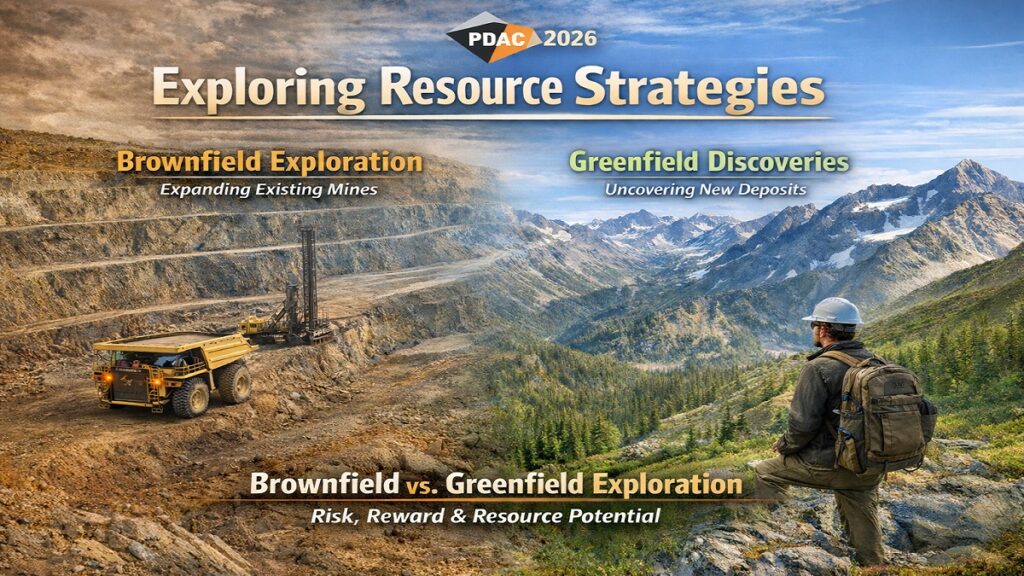
Part of the technical program at PDAC 2026 includes two sessions that examine different approaches to finding new mineral resources:
- Tuesday: The “Brownfield Exploration” session demonstrates how companies expand resources at existing or former mines.
- Wednesday: The “New Discoveries” session showcases greenfield exploration successes.
The approaches differ in risk, capital requirements, timelines, and geological understanding.
Brownfield Exploration Builds on Known Geology
The Tuesday session between 10:30 am and 12:30 pm explores the importance of brownfield exploration. The concept is straightforward: exploring around existing or former mines can be a significant source of additional metal supply, one that economic forecasters often overlook when projecting future production.
Richard Schodde of MinEx Consulting will present on how brownfield exploration contributes to additional copper supply by extending mine life. The expansion of known deposits and the discovery of adjacent resources can contribute to production more quickly than greenfield projects, which typically require longer development timelines. Brownfield projects also carry lower exploration risk because the geology is already well understood.
Neil Burns of Wheaton Precious Metals (TSX: WPM) will discuss why streaming companies are particularly supportive of exploration around active mines. Streamers have financial incentives to fund or encourage brownfield programs that extend mine life or increase production, as they already hold streaming agreements. This alignment means exploration success can translate directly into incremental value realization.
The session will present case studies from several countries. Antoine Schwartzmann of XXIX Metal Corp. (TSXV: XXIX) will discuss success at past-producing mines in Opemiska, Quebec, and Thierry, Ontario. These properties had previous production, and modern exploration techniques are finding additional resources that earlier work missed.
Work at the Muruntau gold deposit will be presented by J. Kelly Cluer of Navoi Mining and Metallurgical Company and by the Institute of Geology and Geophysics of Uzbekistan. Muruntau is among the largest gold deposits in the world and exploration continues to add resources decades after its discovery. This case demonstrates how even giant deposits can yield additional discoveries.
Tom Wise of the Geological Survey of South Australia will talk about IOCG exploration in the Gawler Craton, examining brownfield work in a region known for iron oxide copper-gold mineralization.
New Discoveries from Greenfield Exploration
The Wednesday session between 10 am and 11.30 am will focus on recent economic discoveries and project revivals. These are primarily greenfield projects in which there was no prior production.
Yaya Ouattara of Aurum Resources Limited (ASX: AUE) will discuss the Cote d’Ivoire gold rush. The company increased the resources of Boundiali to 2.41 million ounces through drilling. It is a genuine discovery in a nation that has never been a significant gold producer, despite the geology suggesting potential.
Jason Wilkinson of Millennial Potash (TSXV: MLP) will talk about the development of Banio in Africa. The project aims to establish potash production outside of the traditional locations, such as Canada and Russia. Greenfield potash projects have various challenges, including demonstrating the quality of resources and constructing new infrastructure.
Conor McKinley of Onyx Gold (TSXV: ONYX) will discuss the Argus North discovery at the Munro-Croesus project in Timmins, Ontario. This is interesting since Timmins has more than a hundred years of mining and new discoveries continue to emerge. The boundary between brownfield and greenfield may be obscured in old mining camps where new targets are not directly related to the existing mines.
The Valeriano copper-gold project in Chile, which is said to be a new giant, will also be discussed during the session. Chile is a copper country, and it is still difficult to find deposits that can be called giants. The presentation highlights what makes this project significant compared to typical discoveries.
One of the top uranium districts in the world will be discussed in a presentation on the high-grade uranium discoveries at the JR and Tetra zones in the Athabasca Basin by F3 Uranium (TSXV: FUU). The Athabasca Basin has a rich history of exploration, but high-grade areas continue to be discovered.
Risk, Return, and Resource Replacement
The contrast between these sessions reflects fundamental exploration economics:
- Brownfield exploration offers lower discovery risk because the geology is known. The discoveries may be smaller, since they are satellites to known deposits or mine life extensions. Infrastructure already exists, reducing capital costs and shortening timelines to production.
- Greenfield exploration is riskier since firms are testing geology in regions where there is limited data. Success rates are lower, but the discoveries can be bigger and can form completely new mining districts. Capital costs are higher since infrastructure must be built, and permitting timelines are longer.
Both approaches are necessary for maintaining the global mineral supply. Brownfield work extends production from known deposits and can respond more quickly to supply deficits. Greenfield exploration is required to replace depleting reserves and discover the next generation of major deposits.
These sessions provide practical examples of the two strategies in various commodities and nations. The brownfield presentations demonstrate what is working around current operations. The new discoveries session shows that significant resources continue to be found despite decades of exploration in some regions, while other areas are yielding their first major deposits.
For companies and investors, understanding the distinctions matters. Brownfield-focused companies offer different risk profiles than pure exploration plays. These PDAC sessions provide insight into how each approach is being executed across current projects.