Elemental Altus Royalties Corp. (TSXV: ELE | OTCQX: ELEMF) has signed a definitive agreement to buy EMX Royalty Corp. (TSXV: EMX | NYSE American: EMX) for US$456 million in an all-share deal. The combined company will operate as Elemental Royalty Corp. and aims to establish itself as a mid-tier player in the gold royalty space. The transaction is expected to close in Q4/2025.
EMX shareholders will receive 0.2822 Elemental Altus shares for each EMX share, but there’s a catch. That ratio assumes Elemental Altus completes a planned 10:1 share consolidation first. Without the consolidation, the ratio jumps to 2.822 shares.
Based on 20-day volume-weighted average prices from early September, the offer represents a 21.5% premium.
After the deal closes, existing Elemental Altus shareholders will own about 51% of the new entity. Former EMX shareholders get the remaining 49%.
Tether Investments is providing a US$100 million private placement to support the transaction and clear out existing debt.
Size Matters
The merged company will have 16 producing royalties and over 200 assets in the pipeline. The portfolio tilts heavily toward precious metals at 67%, but also has meaningful exposure to copper and other base metals.
Management expects the combined entity to generate around US$80 million in adjusted revenue by 2026.
Three assets stand out:
- Caserones in Chile: The merger triples Elemental’s stake in this producing copper-molybdenum royalty.
- Timok in Serbia: A long-life gold-copper project that gives the company a unique footprint in Europe.
- Karlawinda in Australia: Provided steady gold production in a safe, mining-friendly jurisdiction.
Why This Deal Happens Now
Smaller royalty companies have a problem. They need scale to attract institutional money and get on major indices. The mid-tier bracket has thinned out lately as consolidation picks up across the sector.
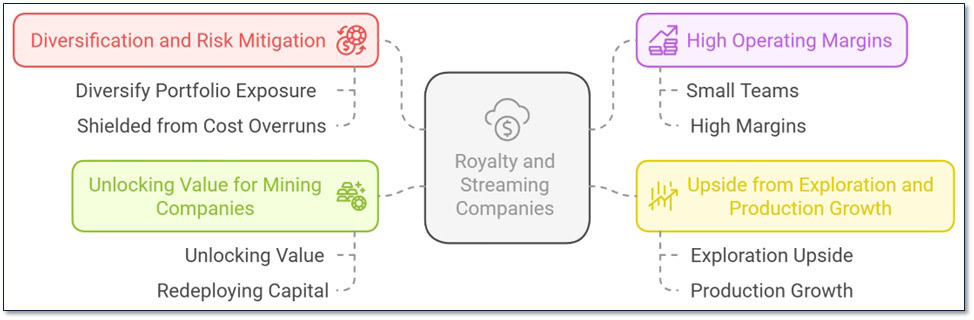
Gold prices hitting record highs doesn’t hurt either. Mining companies want exposure without the headaches of actually running mines. Royalty deals let investors ride commodity prices while avoiding operational risk and capital requirements.
The copper angle matters too. With electrification and clean energy infrastructure ramping up globally, base metals exposure is becoming more valuable. The portfolio gives shareholders a play on both trends.
Who’s Running It
David Cole, currently CEO of EMX, will lead the combined company as CEO. Frederick Bell, who runs Elemental Altus now, moves into the President and COO role.
Cole said the merger gives shareholders more discovery potential across a much larger portfolio. Bell focused on how the deal combines Elemental’s M&A track record with EMX’s ability to generate royalties from scratch through exploration partnerships.
What Needs to Happen
The deal isn’t done yet. It needs approval from 66 2/3% of EMX shareholders and a simple majority of Elemental Altus shareholders on the financing piece. Court and regulatory sign-offs are required as well.
Once it closes, the company will trade on the TSX Venture Exchange under the ticker ELE. Management plans to pursue a U.S. exchange listing to boost liquidity and trading volume.
Industry Trends
This deal fits a pattern that has been building in the royalty space. Companies are consolidating to get bigger and spread risk across more commodities and geographies.
Already this year, we have seen several noteworthy deals, including:
- Franco-Nevada (TSX: FNV | NYSE: FNV) announced a US$449 million financing package in January with Discovery Silver (TSX: DSV) on the Porcupine Complex that included a 4.25% net smelter return royalty, a US$100 million senior secured term loan facility, and a US$49 million equity investment.
- Triple Flag (TSX: TFPM) acquired Orogen Royalties (TSXV: OGN) in a $421 million transaction (approximately US$305 million) in April, structured through a mix of cash, shares, and spinout equity. The deal was primarily driven by Orogen’s0% net smelter return (NSR) royalty on AngloGold’s (NYSE: AU) Expanded Silicon gold project in Nevada, also known as the Arthur Gold project.
- Franco-Nevada (TSX: FNV | NYSE: FNV) announced the acquisition of a 7.5% gross margin royalty on the Côté Gold Mine in Ontario for $1.05 billion in May. The mine is operated by IAMGOLD (TSX: IMG) and jointly owned with Sumitomo Metal Mining (TSE: 5713).
- Eagle Royalties (CSE: ER) announced it had entered into a definitive agreement with Summit Royalty for a reverse takeover (RTO) of Eagle. The resulting entity will hold more than 40 royalty and streaming interests, with a primary focus on precious metals.
- Royal Gold Inc. (NASDAQ: RGLD) announced definitive agreements to acquire Sandstorm Gold Ltd. (TSX: SSL | NYSE: SAND) and Horizon Copper Corp. (TSXV: HCU) in deals worth approximately US$3.5 billion and $196 million, respectively.
The royalty model continues to work well as a financing tool. Miners get upfront capital without diluting equity, and royalty companies get exposure to future production at locked-in rates.
For Elemental and EMX, the math is pretty straightforward. Separately, they’re too small to compete effectively for larger deals or attract the institutional capital that drives valuations in this sector. Together, they might have enough scale to matter.
Whether that translates into shareholder value depends on execution, metal prices, and how well the assets actually perform. But the strategic logic is clear enough.
FIGURE 1: Benefits and Strategies of Royalty & Streaming Companies