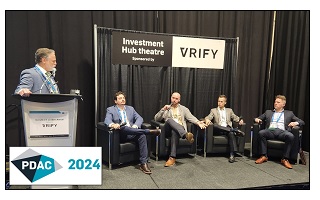
At PDAC 2026, Mark Selby of Canada Nickel Company sat down to discuss the Crawford Project and the broader Timmins district.
The conversation started on a recurring concern as many still question whether low-grade nickel deposits can work. Selby pushed back on that view. He argued that scale, not grade, now drives project economics.
Meanwhile, global demand continues to rise. The industry needs multi-million-tonne deposits, especially outside Indonesia. This sets the context for what he calls a shift in how nickel projects are evaluated.
Economic Even at Low Grades
Selby pointed to operating margins as the key metric. The company expects roughly $30 per tonne in value against $12 in costs. That implies strong margins over a long mine life. In addition, large-scale equipment has changed how these deposits are mined.
However, the comparison to older high-grade camps still lingers. Selby referenced Voisey’s Bay as one of the last large high-grade discoveries. Today, most new discoveries are smaller. Therefore, scale has become more important than grade.
District Scale And Funding Structure
Canada Nickel has built a large land package in Timmins. The company has drilled multiple targets with a high success rate. Several deposits may show better strip ratios than the Crawford project. Selby noted it may not be the best asset, just the first.
Funding remains a key focus. The company outlined a $2.5 billion package supported by debt, tax credits, and strategic partners like Samsung SDI. In addition, carbon capture could store 1.5 million tonnes of CO₂ annually. This positions the project within a low carbon supply chain.
Notes: The author, employees, consultants, and family of eResearch may own stock positions in companies mentioned in this article, report, and/or video, and may have been paid by a company mentioned. eResearch offers no representations or warranties that any of the information contained in this article is accurate or complete. Content on eresearch.com is provided for general informational purposes only and does not constitute financial, investment, tax, legal, or accounting advice, nor does it constitute an offer or solicitation to buy or sell any securities referred to. Individual circumstances and current events are critical to sound investment planning; anyone wishing to act on this information should consult with a financial advisor. The article may contain “forward-looking statements” within the meaning of applicable securities legislation. Forward-looking statements are based on the opinions and assumptions of the Company’s management as of the date made. They are inherently susceptible to uncertainty and other factors that could cause actual events/results to differ materially from these forward-looking statements. Additional risks and uncertainties, including those that the Company does not know about now or that it currently deems immaterial, may also adversely affect the Company’s business or any investment therein. Any projections given are principally intended for use as objectives and are not intended, and should not be taken, as assurances that the projected results will be obtained by the Company. The assumptions used may not prove to be accurate, and a potential decline in the Company’s financial condition or results of operations may negatively impact the value of its securities. Please read eResearch’s full disclaimer.