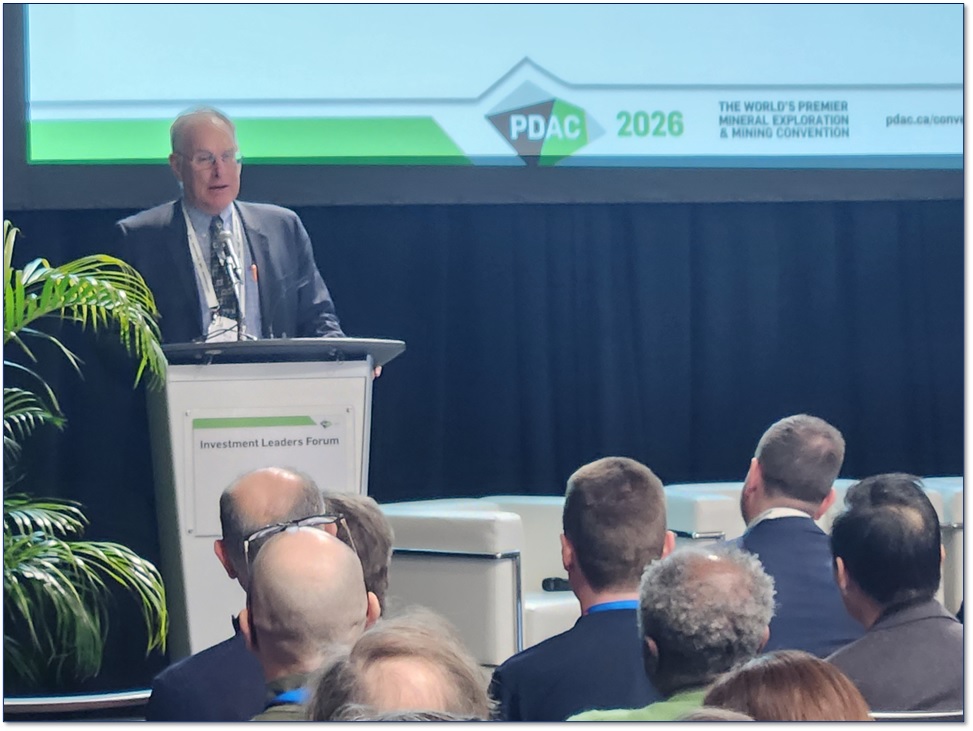
At the PDAC 2026 Investment Leaders Forum, veteran resource investor Rick Rule presented his investing opinions based on today’s world economy.
He believes the world economy is going into a very unusual time of bull markets in both precious metals and industrial commodities, caused by governments devaluing their currencies and decades of underinvestment in mining exploration.
Rule is very straightforward in his macro view. He thinks the US dollar will lose up to 75% of its purchasing power over the next decade. This shift would drive up the price of physical things like gold, real estate, and commodities everywhere.
“If I’m right,” he noted, “it wouldn’t surprise me to see the nominal price of gold increase in a mirror image of that decline.”
Even if the outcome is less extreme, Rule argues that doubling or tripling commodity prices over 10 years remains highly plausible.
And at the same time, supply shortages of energy, metals, and materials in general are becoming a permanent problem. He pointed out that you can’t fix thirty years of too little investment in just two or three years; this is a long-term investment opportunity and not a short-term trade.
Adding High-Risk Bets onto a Solid Gold Foundation
Rule’s positioning in gold reflects a shift along the risk curve. Having accumulated physical gold and high-quality producers for decades, he is now reducing incremental exposure to “beta” and moving toward “alpha”, that is, speculative mining equities.
But he was careful to say that this change depends on the circumstances. Rule said he does the sensible thing before he does the risky thing, “I did the common sense before I do the nonsense.” He emphasized that you should only make speculative investments after you have a base of safer investments.
For investors, his takeaway is clear:
- Investors should keep their “safe” money in gold and the big mining companies, but it could be a good time to bet extra cash on smaller, riskier projects, as long as you actually do the research first.
- Rule also cautioned against herd behavior. Last year’s outsized returns in mining equities are unlikely to repeat. “If your expectation is 2025 repeated… forget about it,” he said, pointing to the need for tempered return expectations and disciplined capital allocation.
Structural Supply Deficits in Battery Metals and Industrial Commodities
Beyond precious metals, Rule also sees opportunities in copper and energy, the basic materials we need to build power grids and new infrastructure. The investing thesis is simple: companies haven’t spent enough money on new mines or plants recently, so there isn’t much supply coming. Meanwhile, the world’s demand for these materials is only growing.
“We’ve underinvested in oil, we’ve underinvested in copper… all of them,” he said. The result is a structural imbalance that cannot be resolved quickly.
Even though Rule didn’t single out battery metals specifically, his ideas matter a lot for things like copper and other metals used in the green energy shift. Investors should focus on:
- Long-life assets
- Projects with permitting visibility
- Companies with access to capital
However, the most obvious opportunities in these areas might already be too popular, meaning the best deals might already be gone.
Buy Hate, Sell Love
Rule’s most actionable and controversial insight lies in his renewed focus on micro-cap exploration equities. After years of favoring developers and near-term producers, he now sees value in the most neglected segment of the market.
“90% of exploration stocks worldwide are permanently undervalued,” he stated. “That means the risk-adjusted net present value is zero.”
It is this inefficiency that creates opportunity. The remaining 10% of companies can generate outsized, asymmetric returns. This aligns with Rule’s long-standing contrarian framework: “Buy hate, sell love.”
Right now, Rule says it’s hard to find stocks that everyone absolutely hates, but finding ones that everyone is bored with is the next best thing. Big professional investors are completely ignoring the tiny exploration companies because they require too much work to research and might not ever find anything.
The biggest problem is that most regular people don’t actually know how to pick these winners. Rule warns that buying a little bit of everything without knowing what you’re doing is a huge mistake. In his view, the fastest way to lose all your money in mining is to “got a hunch, bet a bunch” instead of doing the actual work.
Jurisdictional Risk is a Price Variable, not a Switch
While most investors gravitate toward Tier 1 jurisdictions, Rule is actively deploying capital into frontier markets where risk is higher, but so are potential returns.
“I would much rather own a deposit worth stealing in a country I’m afraid might steal it from me,” he said, “than a deposit that isn’t worth stealing in a good country.”
Based on decades of experience, Rule is flipping the script on what people usually call a “safe” jurisdiction. He points to examples in North America where new laws or high taxes shut down projects.
For investors, this means rethinking the idea that some countries are always safer than others. While political risk is real, it’s often mispriced. Sometimes, the best deals could be in “scary” places where no one else is brave enough to put their money, meaning there’s way less competition for the best projects.
Offshore Energy Exploration as an Unloved Trade
In oil and gas, Rule identified a niche opportunity in conventional offshore deepwater exploration, particularly in less favorable jurisdictions. While shale and North American plays have investors’ interest, offshore projects remain underfollowed.
“What I want is conventional, deep offshore… in places people hate,” he said.
His approach is based on four factors:
- Experienced management teams
- Strong seismic data
- Nearby producing analogs
- Asymmetric return profiles (15:1 or better)
Volatility as Opportunity
Rule wrapped up with a reality check based on history. He compares today to the 1970s, pointing out that even when prices are mostly going up, there will be huge, sudden drops along the way.
“There will be volatility,” he warns, “…and it will scare the hell out of you.”
His advice is to get your investing game plan ready before the chaos hits:
- Maintain a buy list
- Define investment theses in advance
- Act decisively during market dislocations
For Rule, volatility is not risk; it’s the way to actually make some serious money.
Systemic Issues Create Opportunities
Even though it wasn’t the main part of his talk, Rule mentioned his ongoing involvement in launching Battle Bank.
This move shows that he really doesn’t trust the traditional banking system or the stability of “paper” money like the U.S. dollar. It all fits into his bigger theory that governments are constantly watering down the value of their currency, making your cash worth less over time.
Actionable Takeaways
For both retail and institutional investors, Rule’s framework can be distilled into several key points:
- Build a core portfolio of high-quality assets first: Put your “safe money” into high-quality assets (like gold or major companies) before you do anything else.
- Pick your “moonshots” carefully: Only put your extra cash into risky stocks, but they should have a chance to pay off big (5x to 10x).
- Go where others aren’t: Look for sectors that are “unloved” or ignored. If everyone is talking about a stock on social media, it’s probably already too expensive.
- Jurisdictional risk should be a pricing variable, not a yes/no switch: Instead of saying “I’ll never invest in Country X,” look at the actual math. Sometimes the country risk is already baked into a super-cheap stock price, making it a better deal.
- Buy the dips: When the market swings wildly and prices drop, use that as your chance to get in cheap. Don’t let a scary headline talk you into selling.
The most important thing Rule wants you to know is that investing requires work. To him, “speculating” isn’t gambling or guessing; it’s a job.
You have to do the heavy lifting and the boring research to find the deals that everyone else is too lazy to look for.
Or, as he put it succinctly: “If you don’t do the work… don’t blame me.”
FIGURE 1: Rick Rule at the Investment Leaders Forum at PDAC 2026
Notes: The author, employees, consultants, and family of eResearch may own stock positions in companies mentioned in this article, report, and/or video, and may have been paid by a company mentioned. eResearch offers no representations or warranties that any of the information contained in this article is accurate or complete. Content on eresearch.com is provided for general informational purposes only and does not constitute financial, investment, tax, legal, or accounting advice, nor does it constitute an offer or solicitation to buy or sell any securities referred to. Individual circumstances and current events are critical to sound investment planning; anyone wishing to act on this information should consult with a financial advisor. The article may contain “forward-looking statements” within the meaning of applicable securities legislation. Forward-looking statements are based on the opinions and assumptions of the Company’s management as of the date made. They are inherently susceptible to uncertainty and other factors that could cause actual events/results to differ materially from these forward-looking statements. Additional risks and uncertainties, including those that the Company does not know about now or that it currently deems immaterial, may also adversely affect the Company’s business or any investment therein. Any projections given are principally intended for use as objectives and are not intended, and should not be taken, as assurances that the projected results will be obtained by the Company. The assumptions used may not prove to be accurate, and a potential decline in the Company’s financial condition or results of operations may negatively impact the value of its securities. Please read eResearch’s full disclaimer.