
Early this week, Discord submitted its confidential filing to the SEC, indicating a possible March IPO and marking the end of a two-year wait-and-see period in Silicon Valley. Discord’s roadshow will not be only about its valuation; it will be a gauge of investor appetite in a market that has been starved of high-growth tech listings since 2021.
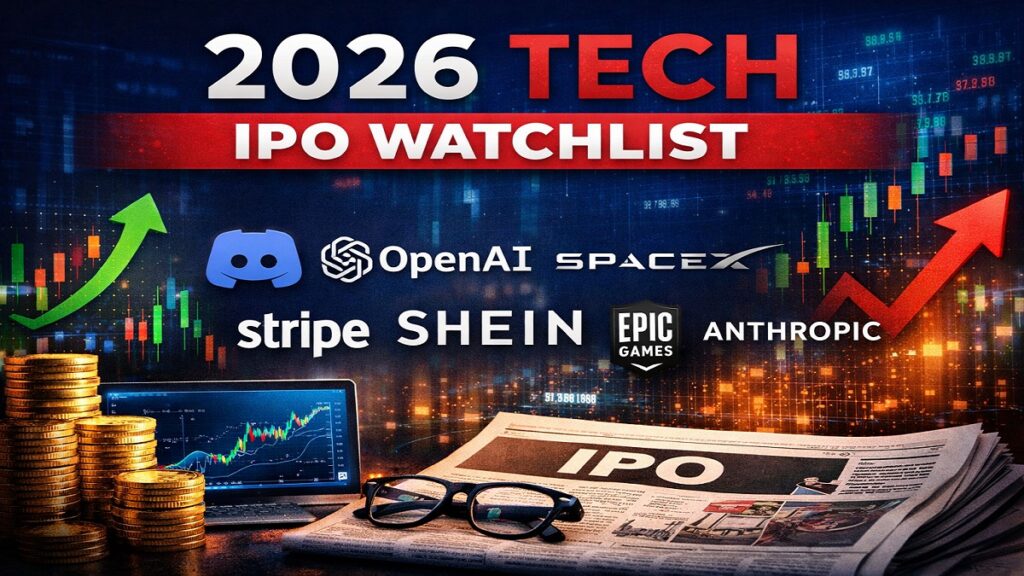
Following two years of turbulent markets and an almost complete freeze of key tech listings, 2026 is already becoming the most expected IPO year since the 2021 boom. Bankers claim that the window is open but picky, and investors are rewarding profitable growth, AI-based business models, and businesses with clear cash flow avenues.
It is against that backdrop that a group of high-profile private tech companies is about to test public markets, some of them for the first time, others after years of false starts.
The Retail Reality: Is There Any Alpha Left?
To the retail investor, the 2026 IPO wave is a two-sided sword. In contrast to the dot-com era, when companies were going public at an early stage of their lifecycle, the current unicorns are remaining private for a decade or longer.
- The Private Profits Problem: Before a company such as Stripe or SpaceX goes to the NASDAQ, it has already experienced dozens of private funding rounds. The 100x or 1,000x returns have already been taken by the private equity firms and venture capitalists.
- The Liquidity Trap: When a company is launched at an $80 billion or $100 billion valuation, it is already a mature giant. Retail investors are not getting in on the ground floor; they are frequently supplying the liquidity to early investors to get out. In order to succeed in the 2026 class, retail players need to go beyond the brand names and examine whether there is real room to grow by multi-baggers or whether the easy money has been made behind closed doors.
Here’s a breakdown of the most credible candidates, grouped by sector, along with the latest signals on timing, valuations, and financial readiness.
Core AI & Deep Tech
- OpenAI
- The most closely followed potential IPO of the year is OpenAI. The valuation of the company has soared to $80 billion in early 2024, then to $157 billion in October 2024, and most recently to about $500 billion in October 2025.
- The question of profitability remains open. OpenAI makes billions of dollars in revenue and spends a lot of money on model training and computing. Bankers indicate that the company may file confidentially in case market conditions are stable, but the leadership has publicly denied the urgency of an IPO.
- Anthropic
- Anthropic has become the most credible competitor to OpenAI, raising several multi-billion dollar rounds of Amazon, Google, and other strategic investors. The valuation of the company has increased significantly, reaching up to $183 billion after its September 2025 Series F round, and has been reported to reach up to $350 billion with investments by Microsoft and Nvidia in November 2025.
- Similar to OpenAI, it is not profitable yet, but its growth in revenue has been steep, and its enterprise-oriented positioning is attractive to the investors of the public market. A late 2026 IPO is a possibility should the company keep scaling its Claude platform and diversifying revenue.
- SpaceX
- SpaceX is the biggest privately owned company in the U.S., and its valuation reached about $800 billion in December 2025 through insider share sales. Recent reports indicate that IPO talks are valuing it at up to $1.5 trillion. Elon Musk has repeatedly indicated that he would rather remain private, but bankers observe that the maturing Starlink business of SpaceX may warrant a partial spin-out.
- Starlink itself is profitable in terms of EBITDA, and a standalone listing has been floated. If any SpaceX-related entity goes public in 2026, Starlink is the most likely candidate.
- Although SpaceX is the jewel of the private market, investors are considering the possibility of a “holding company” discount. Traditionally, conglomerate-type organizations are valued at a lower aggregate value than the aggregate of their components. In the case of SpaceX, a separate Starlink IPO would probably fetch a higher multiple because of its recurring, predictable revenue.
- Moreover, the concentration of Elon Musk in Tesla, X (previously Twitter), and xAI has added a new dimension of key man risk. Although his visionary position is pushing valuations higher, his recent political and social entanglements have caused some institutional desks to become more cautious. A 2026 listing would be more or less a referendum on whether the Musk Premium remains worth the volatility of his personal brand.
- Anduril
- Defense tech unicorn Anduril has emerged as a significant contractor of autonomous systems, border security, and AI-enabled defense platforms. The valuation of the company has increased significantly, reaching about $14 billion by mid-2024 and allegedly up to $20 billion in late 2025 funding talks.
- Anduril has good government contracts and better profitability ratios, which would qualify it as a company that would be rewarded by the public markets, particularly with geopolitical tensions and increased defense budgets. Bankers indicate that a late 2026 filing is possible.
Consumer & Social Platforms
- Discord
- In early 2026, Discord confidentially registered with the SEC, aiming at a possible spring or summer listing. The company had already considered an IPO in 2021 and had acquisition discussions with Microsoft, but remained private.
- Discord is already generating hundreds of millions of dollars in revenue each year and has been driving towards profitability with premium subscriptions and partnerships. It has a high brand recognition and a sticky user base, making it one of the most expected consumer IPOs of the year.
- Epic Games
- Epic has been IPO-ready long enough, but legal disputes with Apple and Google postponed any public market action. Fortnite is still a cash generator, and Unreal Engine licensing is on the rise.
- The company has been valued at over $30 billion, but secondary markets have been volatile. The profitability fluctuates annually, yet its size and diversified income make it a viable 2026 candidate.
- Shein
- Shein has been planning a U.S. listing for over a year, but political scrutiny has slowed the process. The company is very profitable and among the largest e-commerce players in the world. Shein may become one of the largest consumer IPOs of the decade if regulatory hurdles are reduced.
Fintech
- Stripe
- Stripe is the perennial “any-year-now” IPO candidate. In 2023, the company reorganized its cap table, repurchased shares of its employees, and has been working with greater discipline.
- Although not always profitable, Stripe has a good cash flow and is one of the most valuable private companies in the world, with a valuation of approximately $70 billion as of late 2024. Bankers indicate that Stripe may file promptly in case markets remain open.
- Chime
- Chime has been gearing up for an IPO since 2021, but postponed it because of profitability issues. The neobank has since reduced expenses and enhanced unit economics. As fintech sentiment rebounds, Chime may reconsider a listing in late 2026.
- Klarna
- Klarna has experienced one of the most radical turnarounds in fintech, cutting losses and bouncing back to profitability. The company has been very vocal about the timing of an IPO. Its last round of funding was worth about $6.7 billion. As the adoption of Buy-Now-Pay-Later (BNPL) levels off, Klarna is a viable 2026 entrant.
- Motive
- Motive (previously KeepTruckin) has grown to include AI-based safety and logistics in addition to fleet management. The company has been scaling revenue at a multibillion-dollar valuation and has raised capital. Profitability is in its infancy, but its enterprise orientation makes it appealing to the public market investors.
Enterprise SaaS
- Canva
- Canva is among the most valuable privately held software firms in the world, having a valuation of over $32 billion as of late 2024. The company has been developing a U.S. leadership team and enhancing enterprise penetration, classic pre-IPO indicators. Canva is a profitable and expanding company, which makes it one of the most powerful SaaS nominations in 2026.
- Rippling
- Rippling has expanded quickly in HR, IT, and payroll software, with valuations of over $11 billion. Although it is not profitable yet, its growth rate and growing product line have been compared to Workday. An IPO can be done late in 2026 in case markets are still open to SaaS names.
Final Thoughts
The 2026 IPO market could represent a new normal. The near-freeze of the mid-2020s has left a backlog of high-quality, battle-tested companies. For the market, this is a sign of health; for the retail investor, it is a time for extreme discipline.
The winners of 2026 won’t necessarily be the most famous brands, but the ones that can show profitability and prove their AI stories are driving real cash flow rather than just hype.
The Class of 2026 should not be viewed as a “gold rush”, but as a time to identify long-term compounders, and investors must be cautious of the Musk Premium and the high cost of entry set by the delays of the private markets.
Notes: All numbers in USD unless otherwise stated. The author of this report, and employees, consultants, and family of eResearch may own stock positions in companies mentioned in this article and may have been paid by a company mentioned in the article or research report. eResearch offers no representations or warranties that any of the information contained in this article is accurate or complete. Articles on eresearch.com are provided for general informational purposes only and do not constitute financial, investment, tax, legal, or accounting advice nor does it constitute an offer or solicitation to buy or sell any securities referred to. Individual circumstances and current events are critical to sound investment planning; anyone wishing to act on this information should consult with a financial advisor. The article may contain “forward-looking statements” within the meaning of applicable securities legislation. Forward-looking statements are based on the opinions and assumptions of the Company’s management as of the date made. They are inherently susceptible to uncertainty and other factors that could cause actual events/results to differ materially from these forward-looking statements. Additional risks and uncertainties, including those that the Company does not know about now or that it currently deems immaterial, may also adversely affect the Company’s business or any investment therein. Any projections given are principally intended for use as objectives and are not intended, and should not be taken, as assurances that the projected results will be obtained by the Company. The assumptions used may not prove to be accurate and a potential decline in the Company’s financial condition or results of operations may negatively impact the value of its securities. Please read eResearch’s full disclaimer.