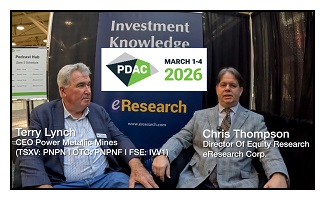
The technical program at PDAC 2026 features a number of sessions that discuss the integration of artificial intelligence (AI) and advanced geophysical techniques into mineral exploration.
These sessions go beyond theoretical talks and introduce applications and case studies from operating companies and service providers.
Mining meets AI: Monday, March 2, 2 pm to 3:55 pm
- Cameron Schuler of the Vector Institute introduces the session by exploring the value proposition of AI in mining.
- Gan Duan from Datarock will present computer vision in geology. This presentation includes AI case studies.
- Alexander Wilson from Bentley Systems will present how machine learning can be used to speed up the creation of structural geological models.
- Mike Olsen from SRK Consulting will discuss large-language models (LLMs), describing them as reliable tool creators but unreliable oracles.
The session concludes with a roundtable with panelists from Krux Analytics, SRK Consulting and Equivest Metals. They will discuss the possible applications and challenges of implementing AI in the mining sector, as it creates both excitement and doubt, considering mining’s history with new technologies.
Advanced Geophysical Techniques
Two sessions are devoted to geophysical approaches, each of which provides a different point of view:
- “Geophysics: Integrated Exploration Case Histories” from 2 pm to 4 pm on Tuesday
- The Tuesday afternoon session is more of a case history of integrated exploration across various jurisdictions. Irvine R. Annesley, University of Saskatchewan, discusses geophysical-geological exploration of rare-earth-element mineralisation. Other presentations include the Inukshuk Ni-Cu-PGE deposit and uranium exploration at McArthur River in Saskatchewan.
- Stephen Hallinan from Viridien will discuss the Jervois project in the Northern Territory of Australia, which is concerned with magnetic-image-guided 3D magnetotelluric and gravity inversion modelling. Further case studies of magnetotelluric are given by Naser Meqbel, 3D Consulting-GEO. These presentations give real-life examples of how various geophysical methods are used together to address certain exploration issues.
- “Cutting-Edge Geophysics for Mineral Exploration” on Wednesday from 10 am to 12 pm.
- Newer technologies are discussed in the Wednesday morning session. Doug Schouten of Ideon Technologies introduces cosmic-ray muon tomography with multiphysics methods. The method involves the utilization of naturally occurring subatomic particles (muons) to image subsurface geology, a truly new technique as opposed to the conventional techniques.
- Nicholas Williams, from KoBold Metals, will discuss joint gravity and magnetic stochastic inversion as a means of minimizing the exploration risk. Xcalibur Smart Mapping, Stephen Reford, deals with machine-learning applications in airborne geophysics.
Technology in Regional Contexts
There are also region-specific sessions that use technology applications. These presentations showcase how machine-learning tools are being used in specific geological environments.
- On Sunday, March 1, from 2 pm to 4 pm, there is the Latin America session, which includes Sebastian Benavides of Anglo American on the Quellaveco copper operation in Peru. In his presentation, “Unlocking Depth and Data: How Quellaveco is Redefining Copper Mining Through Exploration and Technology”. He highlights how the company uses digital tools for both production and ongoing exploration.
- The brownfield exploration session on Tuesday morning, from 10:30 am to 12:30 pm, includes a presentation on AI used in iron-oxide copper-gold exploration in Chile.
What These Sessions Highlight
The format of these meetings indicates the level of technology adoption in the mining industry.
The AI session directly addresses issues and constraints. The geophysics sessions combine new methods with proven ones, and some of the presentations are devoted to the combination of different types of data instead of single-technology solutions.
Case studies focus on working examples of operating projects to provide attendees with real implementation experiences, both successes and challenges.
The sessions provide insight into the technologies that are transitioning between experimental and operational applications. The presentations of large producers such as Anglo American and Rio Tinto, as well as junior explorers and consultants, indicate that the use of technology is implemented at various levels of companies and types of projects.
Mining exploration is adopting new analytical tools. However, the tone of some of the sessions, especially the recognition of the limitations of AI and the focus on integration over replacement of the current methods, implies a gradual, not transformative rate of change in the industry.
For more information about the sessions, please visit: PDAC 2026 – Technical Program
Notes: The author of this report, and employees, consultants, and family of eResearch may own stock positions in companies mentioned in this article and may have been paid by a company mentioned in the article or research report. eResearch offers no representations or warranties that any of the information contained in this article is accurate or complete. Articles on eresearch.com are provided for general informational purposes only and do not constitute financial, investment, tax, legal, or accounting advice nor does it constitute an offer or solicitation to buy or sell any securities referred to. Individual circumstances and current events are critical to sound investment planning; anyone wishing to act on this information should consult with a financial advisor. The article may contain “forward-looking statements” within the meaning of applicable securities legislation. Forward-looking statements are based on the opinions and assumptions of the Company’s management as of the date made. They are inherently susceptible to uncertainty and other factors that could cause actual events/results to differ materially from these forward-looking statements. Additional risks and uncertainties, including those that the Company does not know about now or that it currently deems immaterial, may also adversely affect the Company’s business or any investment therein. Any projections given are principally intended for use as objectives and are not intended, and should not be taken, as assurances that the projected results will be obtained by the Company. The assumptions used may not prove to be accurate and a potential decline in the Company’s financial condition or results of operations may negatively impact the value of its securities. Please read eResearch’s full disclaimer.